How I Got Started

I started Butterfly gardening many years ago. My yard has been a progression over the years, and has made many transformations. Twenty years ago I experienced Hurricane Andrew. My yard and house were destroyed. We decided not to replace the pool screening and open up the backyard and put in some landscaping. That was the official beginning of my love for gardening in South Florida. I added a beautiful water garden years ago, and have been adding host and larvae plants for pollinators, mostly for the butterfly, for as many years as I can remember. I had my yard certified as a Natural Habitat, through the National Wildlife Foundation. To have a natural habitat you need to provide and meet certain requirements: 1. Provide a food source, 2. Provide a water source, 3. Cover, 4. A place to raise young. I try not to use any pesticides in my yard. I vermicompost and recycle as many of my food scraps as possible. If I had more land I would have a huge compost bin to recycle all my yard cuttings. Basically, I try to lessen my carbon footprint on this earth. In my own little world or backyard I try to provide an ecosystem in my water garden, provide birdbaths, birdfeeders, hummingbird nectar sources, feeders, puddling areas, host plants and nectar plants for butterflies and other pollinators. I am hoping to raise everyone’s awareness of the importance of saving our Butterflies, Blooms & Bees. Without them our world and food source will be in trouble. I hope you all enjoy my journey. I am not a Master Gardener, or Master Beekeeper, an Entomologist, or Journalists. I am simply a Backyard Gardener who is trying to lessen her Carbon Footprint of this Earth.

I hope you enjoy my blogs.

Tuesday, August 7, 2012

Importance of Saving Seeds from Your Garden

As humans I think we take for granted that our food supply will always be there for us. This may not necessarily be true. Most Americans have never planted a garden; many children have never experienced nor have an understanding where our food supply comes from. I recently saw a beautiful quote on the internet as I was exploring Heirloom Seed Companies. This is from BBB Heirloom Seed and Wildflowers, “To plant a garden is to believe in tomorrow.” Here is another quote: “Why try to explain miracles to your kids when you can just have them plant a garden.” ~Robert Brault

Well, to start with, I just need to say it, I will not use genetically modified seeds in my garden; I use only heirloom seeds. Humans have survived and flourished for thousands of years planting heirloom seeds, and why we decided to start messing with seeds 40 or 50 years ago is beyond me. If we are ever thrown into a world where we need to grow our own food to survive, trust me, you want plants that are grown naturally and contain the most nutrients. Hybrid seeds, and the plants they produce, have been shown to contain much less nutrition than organically grown plants, and often, they require much more maintenance to grow successfully.

As an organic gardener it is very important to save seeds from your plants in the garden. First of all you want to choose seeds from the plants that have proven to do well in your garden. Not every plant is worth keeping. You only want to choose seeds from plants that are worth keeping. Never choose seeds from hybrids. Hybrids are beautiful plants, but the seeds are often sterile or do not produce true to the parent plant. Open pollinated or heirloom, self-pollinated plants are the only varieties that will grow true from seed, meaning the seedlings will be exactly like the parents. These are the seeds worth saving. Open pollinated, which are most of my garden are pollinated by insects, wind and people; these plants cross with others in their family. The only way to maintain the original would be to isolate, which would be very difficult as a backyard gardener.

I have a very large zip lock bag full of different seeds from my garden. I have completely seeded an entire flower bed with the seeds from a few salvia plants. Now I have a garden full of salvia which is very easy to grow and pollinators of all sorts love this plant. Any opportunity I have in my garden I try to save seeds. Throughout the season I save seeds from my sunflowers, Mexican sunflowers, water hibiscus, milkweed, Biden Alba etc. Sometimes it is a slow process separating the seeds, especially from the Mexican Sunflower, but the process is well worth it. Now I always have seeds from some of my favorite plants. I make sure that I dry the flower and seeds completely. I store them in a clean dry envelope. Below are some pictures. Look at the huge sunflower and the end result is a bag full of sunflower seeds to plant for next year.


Always choose seeds from the best plants and make sure they are free from disease. Seeds are mature or ripe when flowers are faded and dry or have puffy tops. Plants with pods, like beans, are ready when the pods are brown and dry. When seeds are ripe they usually turn from white to cream colored or light brown to dark brown. Collect the seed or fruits when most of the seed is ripe. Do not wait for everything to mature because you may lose most of the seed to birds or animals.

Harvesting seeds is important for maintaining unusual or heritage flowers or vegetables. It is a great way to propagate many native plants.

Storing Saved Seed
• Make sure the seed is completely dry, or it will rot or mold in storage • Remove as much of the chaff as possible • Store in a paper envelope, labeled with the variety and year • Place the envelopes into an air tight container, such as a canning jar • Store in a cool, dark, dry place • Stored seed is best used the following year

I am getting ready to prepare an area on the West side of the house for gardening. Right now I have some palms planted. I have bought only heirloom seeds. As I said earlier I refuse to use GMO seeds in my garden. Growing up in the Northeast, a daughter of a farmer from Indiana, I have many fond memories of helping my parents grow, maintain and harvest our family garden. I have never really planted my own vegetable garden in Miami. I have planted herbs and tomatoes but never a full garden. This year will be my first year planting a real vegetable garden. I look forward to experiencing this in Miami. Hopefully I will be able to save some of the seeds from my heirloom plants.

As far as my flower garden I continue to save as many seeds as possible. There are numerous seed saver exchanges, clubs, and listings in magazines like Organic Gardening. Although you shouldn’t base your entire garden on saved seed you may want to give seed saving a try.

Sunday, August 5, 2012

Desensitization Process

I started my desensitization for honeybees at the allergist this week. I am slightly nervous about doing this only because I don’t know how I will react. Actually I am really nervous!! I opted to do a rapid desensitization so that I can get back into my hives as quickly as possible. I asked the nurse on Friday the process. She explained to me that they give a series of 4 shots each day over the next couple of days. On Wednesday I should be up to maintenance dose. Then I will go to the allergist once a month over the next several years until my immunoglobulin’s levels show no reactivity. I hope my bees know what I am going through to keep them.

The first day went well with no reaction at all, except for a little itching. Today is day #2 and I hope it goes as well as yesterday. I believe the doctor told me that these shots are the equivalent of 2 bee stings. I think they need to up the dose quickly because I counted about 11 stings when I had my reaction. Two stings is nothing!! Day #2 is going well with no problems at all, just a little localized itching. The Doctor feels I will do very well through the process. He even gave me an extra shot today. I will repeat the process again tomorrow and next Monday. The doctor wants to be present and he is off on Thursday. Then I will be at maintenance, and will go to the allergist for several years for immunotherapy.


So far so good! I just want this process to go quickly so I never have an anaphylactic reaction again. Of course I will be very well protected and always carry my epi pen in the hives and garden.

Today is day #3 with the rapid desensitization. All is going well with just a little local reaction with some itching. Although after the third shot my B/P did drop significantly. Because of that the doctor wants to be conservative and back off a little bit. I am almost at maintenance so I can come in several times a week until I get up to maintenance. He doesn’t want to take a chance that anything will happen. I agree but want to get to a good level as quickly as possible.

I was talking to a friend about what happened to me, his response was what most people would suggest. “Wouldn’t it just be easier to get rid of the bees?” Yes but ….. There is no way I am doing that right now.

Sunday, July 29, 2012

One of My Favorite Plants in the Garden

Is the Dwarf Red Powder Puff (Calliandra emarginata minima), I have the dwarf version which I keep potted on my patio. I keep it watered and fertilized frequently; it rewards me with hundreds of Red powderpuff blooms. It is a great attractant to hummingbirds, bees, and butterflies. In South Florida our Hummingbird season is opposite of the rest of the country. Our hummingbirds migrate here in the winter which is from October until May. I so look forward to the hummingbirds returning. This is one of their favorite plants. Since this is on my patio they are very trusting because they will come right up to these powderpuff flowers to sip nectar. You can almost see the nectar and pollen on the tip of each one of the flowers.


I also have this tree in Pink (Calliandra surinamensis). It is a much larger version of the dwarf variety. I have it planted in my yard and it is about 20 feet high, with beautiful pink powderpuff flowers, which the hummingbirds and hummingbird moths love. One evening I was outside watching my yard and enjoying all the different wild life and I looked up at the pink powderpuff to see if I saw any hummingbirds in the yard. To my surprise there were many small little hummingbirds helping themselves to the nectar of this lovely pink powderpuff. I was so excited that I called my son to come out and see what a wonderful site. We discovered that they were in fact not hummingbirds but a moth that looks very much likes a hummingbird. Although I have many hummingbirds in the garden these moths look very much like them and at first glance are very easy to mistake for a hummingbird. It is so amazing because the wings of these moths imitate the motion of the wings of the hummingbird. The reason I mention these little incognito moths is that it is the first National Moth Week from July 23-29th. I remember being so excited seeing so many hummingbirds all at the same time, then completely disappointed because they were moths. I have to admit these were amazing looking moths. Happy Moth Week everyone!

Thursday, July 26, 2012

Simply an Update Week!!

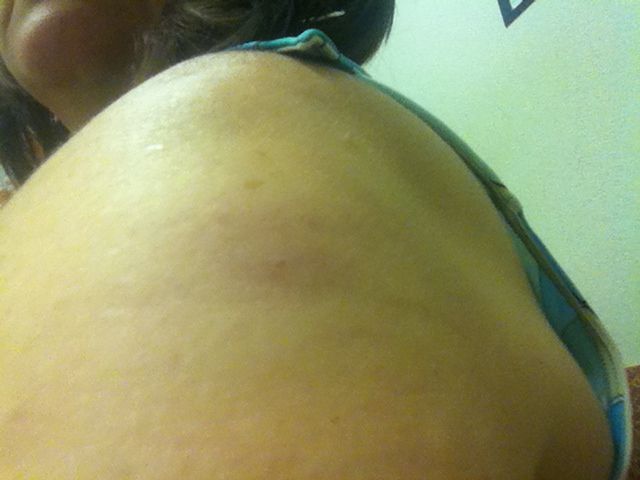
Well it has been quite a week status post my anaphylactic reaction to my bees. My physical wounds are healing. Most of the bruising around my face is gone, my knees are still bruised and butt feels better. My bee stings are hardly swollen or itchy. It’s amazing how 40 mg/day of Prednisone will help alleviate most of the inflammation.


The emotional wounds are taking longer to heal. I had a really hard time in the beginning of the week trying to erase the pictures and vague memories of what I went through in the kitchen. It really is a blur, but what I keep playing in my head is the fact that I was not able to function to help myself. I am so grateful that I came through enough to call 911 and administer the epinephrine. I am in that strange emotional place where I am angry and scared all at the same time. I am not really willing to give up my bees. The thought of having to do this makes me very sad. Every medical person that I have spoken to this week, pretty much thinks I am crazy, and has advised me that I may need to give up my bees until I go through desensitization. I did speak to a few of my bee supply companies. I was advised to put several layers under my gloves instead of ordering new gloves. So I ordered some white cotton gloves as the first layer, then I will put on a pair of my Playtex Kitchen gloves, and then finally my bee gloves. I don’t think the bees can sting through all those layers but they might. It is the “might” that scares me. I also ordered a pair of the most adorable bee rubber boots. I was also advised to take my epi pen out to the bee yard.


According to government statistics, about 3.3 percent of adults will experience anaphylaxis after an insect sting and there are 40 to as many as 100 deaths annually from insect-sting-related anaphylaxis. Anaphylaxis is a severe type I hypersensitivity allergic reaction in humans and other mammals. If you are known to be allergic to insect stings, then the next sting is 60% likely to be similar or worse than the previous sting.

I am still hoping that my friend will help me with the hives so it will decrease the chance of me getting stung. My other concern is the fact that my “bee yard” is my backyard and also my garden. I have been afraid to just go outside and walk around unprotected this week. Although I have butterfly plants scattered throughout my yard most of my pollination garden is on the west side of the yard where my bee hives are located. I need to get out there and garden but with the bees flying everywhere it makes me a little nervous. They have never stung me when I am out in the yard but they have chased me down a few times. I should have the results of my IgE immunoglobulin’s by Monday and then start desensitization. Hopefully the process will go quickly! I need to call my friend Kate in Albuquerque just to talk about my feelings and the process. One other note, I did go out and buy myself a Pandora “Queen Bee” charm. I think that is as close to a real bee as I am going to get for awhile!


On a happier update is my progress of my mango wine! It is doing exactly what is should be and has reached a specific gravity of about 1.010. I removed the mango fruit and I racked it into a secondary carboy on Tuesday evening. It went very smoothly. It is now settling nicely and I will be racking it off the lees every week for a couple of weeks and then eventually every month for at least 6 months. I will periodically give you some updates to show the process.


It’s been a tough week! A good glass of wine is exactly what the doctor ordered!

Sunday, July 22, 2012

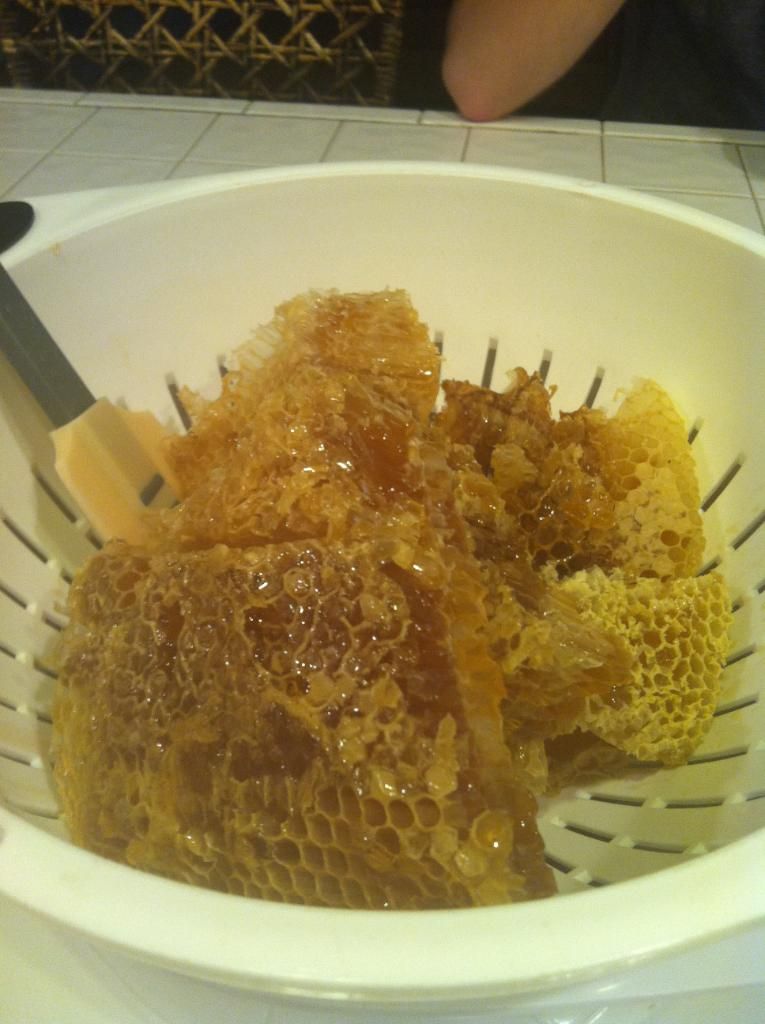
Was this Beautiful Honey worth all the Stings?


The weather here in South Florida has been the rainiest that I can remember in many years. I know the rest of the country is experiencing the worst drought in centuries and that they would be grateful for some of this rain, but for me, enough is enough. In fact, as I am writing this blog it is pouring outside. There is a tropical wave south of us that is pushing moisture in our direction. It is one of those days that you just want to snuggle up in bed or on the couch and read a good book or watch a good movie. It is dark and there is a deluge of rain coming down. It has been a difficult summer as a relatively new beekeeper. First, it took some time to re-queen my hives after the splits. I feel this was mainly due to the weather. It has also made it very difficult to get into my hives on a regular basis. As a Top Bar Hive Beekeeper I like to go into my hives every 10- 14 days tops. The last two times I have gone in it has been more like 14 days, or just over. The last time I was in the hives the bees were crowded and I opened up the brood area for the queen to lay. Being crowded can make the bees very grumpy. Yesterday was mostly sunny; this was going to be my one opportunity to get into the hives. The first hive looked very good. It is a gentle hive, a pleasure to work. The bees are very small. The queen is laying well. There are still a few small hive beetles present but they look better and under control.

When I am inspecting the hive I am looking for many things: first, do I see the queen? What is her laying pattern like? How does the bee population look? Is there honey and nectar, and pollen present? How is the activity of the hive? I try to look at the combs and keep most of the honey comb towards the back of the hive with the brood nest all in one area up towards the front of the hive. Are there any pests present? Are the combs straight? Does the brood nest need to be opened up so the queen has room to lay? Are there brood, larvae, and eggs present? It is important to know the time frame for these different stages so that if there is a problem with the queen you are able to recognize it. I am telling you this because as I went into hive #2 yesterday, the bees were immediately defensive. I smoked the hive well to let them know of my arrival. There was a very heavy comb of honey that I had positioned as the last bar the last time I went into the hive. It still had just a small circular area of brood. I removed it while I worked the hives trying to decide whether I should sacrifice the small brood area for the nice capped honey. As soon as I reached for the second bar the bees came out and stung me on the hand. In fact they chased me for several feet. I gave them a chance to calm down smoked them a little more and discovered many queen cells present. Sometimes when a hive is queenless they can be very defensive. There were numerous capped queen cells present on many of the top bars. This was my opportunity to practice what I learned in Albuquerque, NM. I learned about a mixed origin divide. I left several bars with queen cells in hive #2 for them to make the queen. Then I started selecting out bars of brood, nectar and honey to make the mixed origin divide. This hive is the same hive that several months ago did the same thing as far as the queen cells. I had split this hive and it had made a new queen. She was laying nicely, but two weeks later she was gone and there were numerous queen cells present within the hive. I don’t know if this hive swarmed, or if they didn’t like their queen, or what exactly was happening. So I began examining my hives for the appropriate bars to make the divide. As my inspection continued I got little stings through my gloves. There must have been bees on the ground around hive #4 and I got stung for the first time on my ankle. I continued to select out bars for the divide and was putting them into the new hive that I had resting on the ground. I decided that I was going to take the honey and shook those bees off into the divide. As I did that they stung me in the other ankle. There were two bees stuck under the top of my shoe so I got stung there several times. I went back to hive #3, where I had separated out three bars of brood and nectar that I was going to move over to the divide. As I was doing that I started to feel a funny sensation in my hands. It felt like itching and swelling at the same time. I immediately knew something was wrong. I gathered the bar of honey and went inside. By the time I got inside I couldn’t function to turn my cell phone on to call 911. I was totally incapacitated. In hindsight it is amazing to me that I was unable to do a simple task like turning on my phone and dialing 911. I had gotten certified on the use of the epi pen when I attended Bee College, and because I have had some pretty severe local reactions my Doctor ordered the epi pens for me. Never did I think that I would need them.


At some point I must have passed out. I think I might have had a little seizure as I remember shaking violently before I lost consciousness. I don’t know how long I was out? I don’t know if it was a minute, or several minutes. I know that when I woke up I again tried to call 911. Somehow I had enough cognitive function to dial my phone. The 911 operator stayed on the phone with me. She was very good but I still could not figure out how to open the epi pens. I was telling her I couldn’t see because I had many spots in front of my eyes. Finally I was able to open the pen and administered the epinephrine to myself. I am a nurse so it is mind boggling to me how I struggled to do this simple task. By the time the paramedics arrived I was feeling slightly better. During that conversation with 911 I was nauseous, and felt like I was going to pass out again. I was relieved to see the paramedics. My blood pressure was extremely low 80/60. This was an awful experience. They ended up taking me to the hospital because of the syncope episode, and my B/P being extremely low.

As a beekeeper I cannot stress enough how important it is to be prepared. How many times have you heard of the 30 year beekeeper getting stung and having an anaphylactic reaction. I am a new beekeeper and my local reactions have been pretty severe. Never did I really think that I would have a systemic reaction, but I did. I am so glad that I had the epi pens available. I also want to stress how severe my reaction was, so severe that I did not have enough cognitive function to manipulate my phone or epi pen. That I think is the scariest part of this whole experience. I am very grateful that I am ok and I woke up off the floor. I do have numerous bruises on my knees and butt and I think I must have hit my nose on the way down. It is swollen and I probably will have two black eyes in a day or so. My feet and hands are also pretty swollen from the bee stings. I will survive, and I’m very grateful and very lucky that I am ok.

Again I will ask; was this honey worth all these stings?? Yes!!

Remember I am not necessarily doing this for the honey, although I enjoy all the byproducts of beekeeping. I am doing this for the bees. After my bees settle down I may have to reevaluate my queen situation. Maybe I need to re-queen all my hives with a gentler Italian Queen. I feel that when I am in the hives I am calm and Zen like. This makes me question whether I’m just a terrible beekeeper. As a beekeeper I need to be able to do certain things while I am in the hive. My bees definitely react aggressively. Yesterday when all this happened I was very saddened to think that I may not be able to keep on beekeeping. My long distance mentor Kate, apparently had a similar incident happen to her after getting several stings many years ago. She also lost consciousness. She went through immunization therapy and now has very little reaction to her bees. I am hoping that I will be able to do the same. I would be very sad to give up my bees at this point. I plan on calling my physician and the allergist first thing Monday morning, and start desensitization therapy for bee venom as soon as possible. I also am going to order more protective gloves and boots so the bees can’t sting me.

Now for a little humor around this terrible experience, I am now going to start calling myself the” Sexy Beekeeper”. I decided yesterday that I wouldn’t wear anything but my bra and panties under my bee suit. It is so hot and humid in Miami right now and I sweat through all my clothes. Unfortunately I was not anticipating paramedics entering my house and me not being fully clothed. Many of you probably don’t know that I have a lot of animals. I have several dogs and I am a breeder of sugar gliders. When the paramedics arrived the dogs were barking very loudly. They asked if I was able to move to a quieter area. When they entered my bedroom there are 8 sugar glider cages in my room. They asked me if I was a recue. I said, “ no I breed sugar gliders and those were all my dogs.” They were probably thinking I was some crazy animal hoarder!

I need to find some humor in this terrible experience and have a little laugh. Any sense of privacy was definitely gone as I the “naked beekeeper” had to undress in front of these paramedics. Since I had also left my hives in limbo I had to go back into the hives later that evening to finish closing them up and finish the divide. Talk about getting back on the horse! What a crazy day! I am grateful to have survived!

Visit My Website:
CLICK HERE

Or Visit My Etsy Shop:
CLICK HERE