How I Got Started

I started Butterfly gardening many years ago. My yard has been a progression over the years, and has made many transformations. Twenty years ago I experienced Hurricane Andrew. My yard and house were destroyed. We decided not to replace the pool screening and open up the backyard and put in some landscaping. That was the official beginning of my love for gardening in South Florida. I added a beautiful water garden years ago, and have been adding host and larvae plants for pollinators, mostly for the butterfly, for as many years as I can remember. I had my yard certified as a Natural Habitat, through the National Wildlife Foundation. To have a natural habitat you need to provide and meet certain requirements: 1. Provide a food source, 2. Provide a water source, 3. Cover, 4. A place to raise young. I try not to use any pesticides in my yard. I vermicompost and recycle as many of my food scraps as possible. If I had more land I would have a huge compost bin to recycle all my yard cuttings. Basically, I try to lessen my carbon footprint on this earth. In my own little world or backyard I try to provide an ecosystem in my water garden, provide birdbaths, birdfeeders, hummingbird nectar sources, feeders, puddling areas, host plants and nectar plants for butterflies and other pollinators. I am hoping to raise everyone’s awareness of the importance of saving our Butterflies, Blooms & Bees. Without them our world and food source will be in trouble. I hope you all enjoy my journey. I am not a Master Gardener, or Master Beekeeper, an Entomologist, or Journalists. I am simply a Backyard Gardener who is trying to lessen her Carbon Footprint of this Earth.

I hope you enjoy my blogs.

Monday, July 2, 2012

Bee Art for my Garden

Now that I am a beekeeper I found myself attracted to anything that might be honey bee related. I found some cute little knick knacks at Pier One this weekend. Here are a few pictures. I think they will add a little something special to my garden.


Sunday, July 1, 2012

“Beautiful” Bee Attracting Plants

I have so many different plants in the garden that are attracting many honeybees and native bees. Since I am concerned for all pollinators in general, I have planted many plants in my garden that attract bees, butterflies and hummingbirds. I do know that since I have gotten my bee hives I am much more aware of honeybees in my garden. I am not sure if they are my bees, but the plants that I have planted seem to be very popular with honeybees and native bees. I think their favorite plant is Blue Porter Weed (Stachytarpheta urticifolia). This plant is very easy to grow. It bounces back easily after pruning. One of the nice things about this plant is that it reseeds freely. I have many little seedlings growing throughout the yard. Many I pull, but if the location is right I always welcome a volunteer plant. Porter Weed also comes in a variety of colors such as pink, dark purple, coral and white. I have several in my garden, but the bee’s favorite is the blue. It is pretty impossible to look at the Blue Porter Weed without seeing a few bees on the flowers.


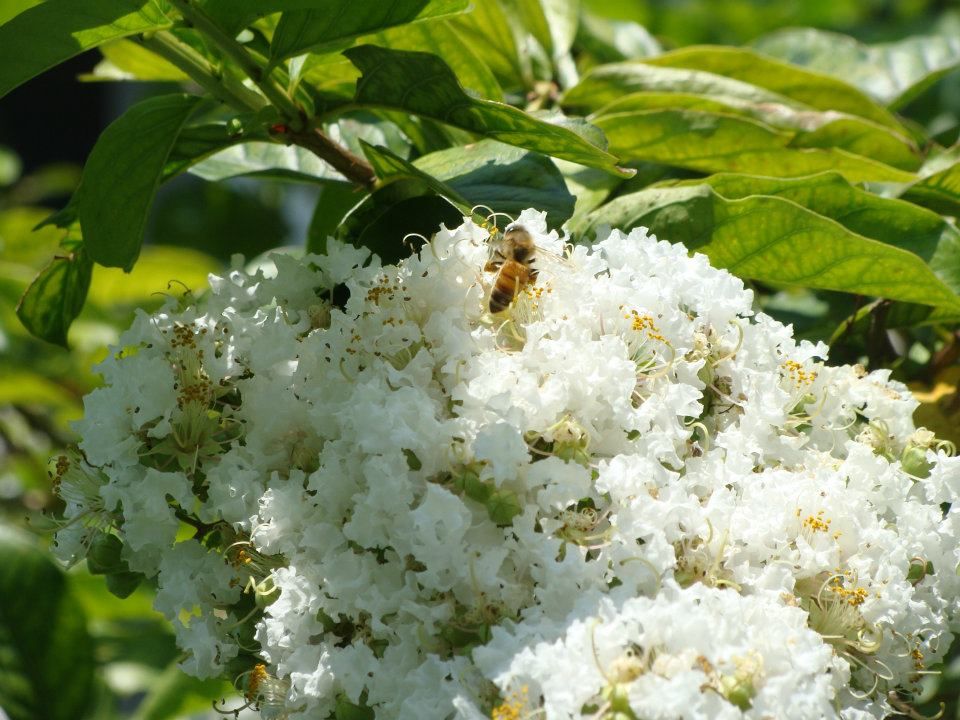
There are a couple of trees that are blooming right now. One is a beautiful Scarlet Red Crepe Myrtle. It is one of my favorite trees. Mine is a couple of years old and I feel that it is struggling at times. I think it should have grown in two years more than it has. I fertilized it very well with both an organic and inorganic fertilizer this year. I try to keep the new growth at the trunk near the ground cut back, but still it is very slow growing. Right now it is in bloom and looks beautiful. Someday this will be a 10-15 ft tree with gorgeous blooms. I was looking at it the other day and discovered it was loaded with honey bees. I was very surprised and happy that my bees have another source for pollen and nectar. My brother was in his yard this morning and said he could hear the bees 30 ft away as they were all over the Crepe Myrtle. The picture of the white Crepe Myrtle is his tree.


The Jasmine Tree Murraya paniculata 'Lakeview' is also in bloom. It has deliciously fragrant flowers that you can smell as soon as you exit the backdoor. I love when this tree is in bloom. I have this tree in a container on my patio. If I were to plant this in the ground it could grow 10-15 ft. I love having it grow on my patio so that when it is in bloom I can experience its delicious fragrance. The bees love this tree. I have also noticed some native bees on this tree. Not sure exactly whether they are yellow jackets or native bees. I need to learn more about the different native bees in Florida. It has only been recently that I’ve put up the mason bee houses.


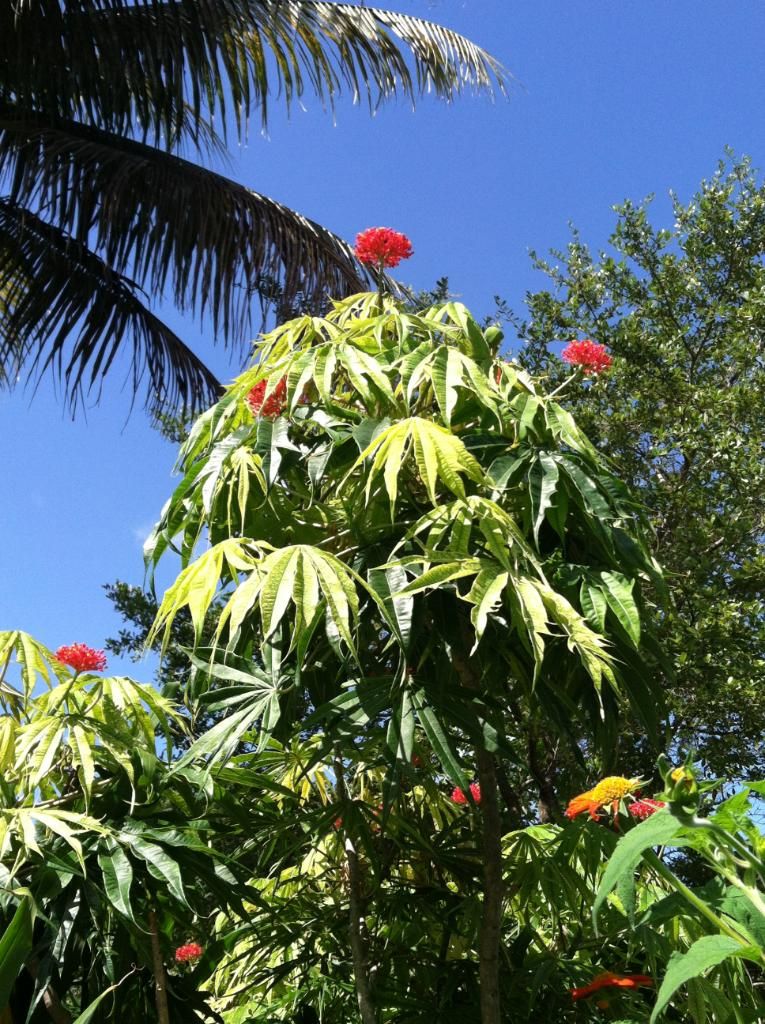
The Jatropha tree is another variety that is one of the bees and butterflies favorite in the yard. Jatropha is a genus of approximately 175 different succulent plants, shrubs and trees (some are deciduous, like Jatropha curcas), from the family Euphorbiaceae. I believe I actually have two different species in my yard, Jatropha Integerrima and Jatropha gossypiifolia. The bees love jatropha integerrima. It has little red flowers. The Jatropha has a tendency to drop its leaves, so it can be a little messy. I have mine around the pool. I always have red flowers and leaves in the pool. The butterflies and bees love it so much that I would never move it to another location. My husband probably would love me to, because he is always skimming up the flowers and leaves. To keep it looking lush and green I prune mine back at least twice a year. The other jatropha tree I obtained many years ago from Butterfly World. It was very small at the time, about 6 inches high, and now it is about 8 ft tall. I was told by Butterfly World that it was from Costa Rica. I believe this species of jatropha was being grown for biodiesel fuel.


When I was at my favorite nursery, Galloway Farms, I saw this plant that seemed to have a lot of bees attracted to it. I was a little worried about how well it would grow here in Miami, because it looked like a succulent, and they told me not to water it too often. With all the rains in Miami I didn’t think it would thrive. I did a little research and found out that it actually would do quite well in South Florida. In fact, they said it was the perfect perennial for South Florida because Bulbine is drought tolerant, grows well in poor soils, and blooms repeatedly with cheerful flowers that are yellow or orange, depending on the variety. It is suited for gardens in USDA Zones 9-11 and is hardy to the low 20s. The succulent, grass-like foliage grows to about a foot tall, while the flower stalks typically reach two feet, dancing above the leaves throughout the summer months. Bulbine was named a 2006 Plant of the Year by the Florida Nursery Growers and Landscape Association. It is generally sold under the scientific name Bulbine frutescens, though some nurseries use the synonyms B. fruticosum or B. caulescens. It has done very well in my garden and the bees absolutely love it. I always see honeybees visiting the flowers and their pollen baskets on their legs are full of pollen. It was definitely a good choice.


I want to add one more pictures of my Mexican Sunflower. It has been well established in my garden and the butterflies absolutely love this plant. I have discovered that a little native bee also loves this flower. I have several pictures of them gathering pollen. I think you should be able to see the little pollen baskets just full of bright yellow orange pollen. They seem to love this composite flower and just kind of sit on the disk being cushioned by all the pollen they are gathering.

Wednesday, June 27, 2012

Rainy Days and Mondays always get me down!

Well today isn’t exactly Monday, but I use to love that song by the “The Carpenters.” With all the rain we’ve had I couldn’t help but sing that song. The phrase isn’t exactly true for me. As a gardener I welcome the rain, but we’ve had so many rainy days here in Miami since May 1st, that I am really over the rain. Mondays, on the other hand, are always difficult! With tropical storm Debbie spinning around in the Gulf of Mexico we have had an excess of rain over the past few days. Luckily the storm headed north, and many parts of northern Florida that were drought ridden have now had an overabundance of rain as the storm was very slow moving. I went out into the garden to check how everything was handling all the wind and rain from the tropical storm. Yesterday was very windy, and today we are still getting the feeder bands from the storm. Everything in the garden was soggy and weeping downward from the rain. Several of the Mexican Sunflowers were leaning over and I had to stake them up. The Popcorn Senna (Senna Alata), which is a host plant for most Sulphur Butterflies, is totally leaning


over. It is just big enough that I am not able to lift it myself. On the east side of the house there is another species of Senna, Cassia Senna (Senna Mexicana), that went through hurricanes Katrina and Wilma. At that time it was uprooted from the ground. My yardman helped me get it up right, but it always has had a little lean to it. I haven’t taken it out because it is a great host plant for the Yellow Cloudless Sulphurs, all the Senna family are. I have noticed the last few days that the branches of the tree are almost touching the ground. When I was walking around the yard this morning I noticed that the trunk has split in half. Unfortunately, I think it’s time for that tree to come down.


I don’t know what it is about my yard, but I swear that somehow the wind just swirls around my house. The west side is always very susceptible to wind damage. Many years ago we added an addition on our house. I think it is the way the addition sits on the property that makes the wind circulate around the addition and creates a little wind tunnel. It is so frustrating though because it just kills me when one of my plants breaks or is falling over. I think it is called Murphy’s Law! Most of my neighbors are not into gardening. I am not really sure it would be fair to say that they wouldn’t care if a tree or plant would be damaged, but it seems like they never have any damage to their yards. Mine, the wind blows, and down go the plants. WHY??

I think when these things happen to my yard I need to take a step back, and realize that I have no control over Mother Nature. My yard has changed so many times over the years due to storms. I need to just accept this change and move on. That is very difficult as a gardener. Actually I think change is one of the hardest things to accept for most people!

Monday, June 25, 2012

Mango Madness Continues

I had a really busy week this week with work deadlines. I also had personal deadlines as my daughter Katie, her boyfriend Tyler, his cousin Aaron and his wife Amanda were coming in just for the night on Friday, on their way from Rochester, NY to Jamaica. With everything I had to accomplish I found myself just wanting to continue with my “Mango Madness” and make Mango Jam and Mango Bread. My Lancetilla tree is almost finished producing fruit and most of the fruit has ripened at this point. I have eaten so many mangos in the past few weeks. I have a delicious recipe for Mango Salsa which has become a tradition. It is very easy to make, so refreshing, which I just serve with nachos.

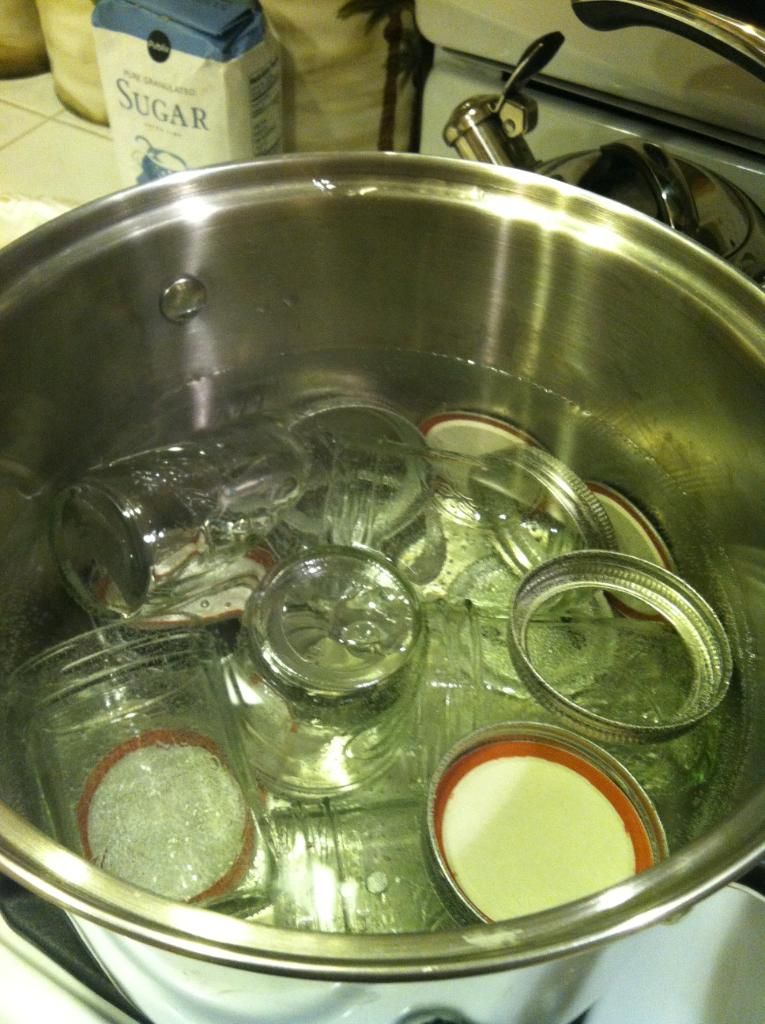
I am not the kind of cook that measures ingredients exactly. In fact, I am the kind that looks at different recipes and says “ok this looks good from here, and I’ll add that from there.” Usually this works very nicely for me. Making jellies and jams always concerns me because I know it is important to have the right amount of fruit to sugar to pectin ratio. I thought I added the exact amounts but could tell the jelly wasn’t quite setting up the way it needed to. I tried a little twist on my normal Mango Jam and added some orange rind to make Mango Marmalade. I grew up with my mom making marmalade and just love the flavor. I think that the orange compliments the mango very nicely. Well the jelly didn’t set up properly so the next day I found myself re-cooking it and adding another box of Sure Gel. I think that is exactly what it needed. Now I have several jars of beautiful Mango Marmalade Jam to give to family and friends.


Somehow when you are the busiest you find time to get everything completed. I don’t know how that is possible. I had to be very disciplined this week and set goals and deadlines so I could complete everything that I had on my agenda. I completed all my deadlines for work and took the day off on Friday to clean the house in preparation for my daughter’s arrival. My four children are scattered across the U.S. I am so excited when they come to visit, and hate them being so far away. Unfortunately because of bad weather in the New York area the plane was diverted to Detroit and they never arrived here in Miami. Well what can I say, we were disappointed, but I do have a really clean house. I was able to see her briefly in the airport on Saturday morning just long enough to exchange hugs and bring Miley, her adorable Pomeranian, home so Grandma could babysit her for the week.

Well back to the Mango Madness. Since my plans for the weekend changed with my daughter’s visit cut short, I decided I should try to use some more of the mangos and make Mango Bread. I made two different recipes. One of the breads was a traditional recipe and the other I found had a Caribbean twist. The traditional recipe is a recipe I got from my mom many years ago for Zucchini Bread. I just added a cup of fresh mango to the recipe. The other recipe had ingredients such as ginger, rum soaked raisins, toasted coconut, mango puree and chocolate chips. Both were delicious. The mango puree in the second recipe was so delicious I wanted to drink it all before it went into the recipe. The puree gave the bread a beautiful golden mango color. I also added a cup of mango chunks just because I like to see the mango pieces in the bread.


Next weekend my daughter and her travelling companions will visit just for the night on their return to Rochester. I will get to visit with her and give her some mango jelly, chutney and mango bread to bring back with her, oh and of course Miley will be leaving to go back with Katie and Tyler.

Well despite all the jellies and bread making this week I still have mangos left. Tonight I cut the rest up, made some plain mango jelly, the rest I will freeze so I can enjoy them throughout the year. Hence the Mango Madness continues!!


I found out tonight that Miley, my grand dog, is a big fan of mangos also. All the dogs were at my feet just waiting for a taste. Miley was especially excited about her mango treats. Paco, my male Chihuahua has been enjoying the mangos all season as they have fallen off the tree. He reminded me of Marley in “Marley and Me” always outside eating the mangos that were on the ground. I haven’t mentioned that I also have a Pot Belly Pig, whose name is Moo. Moo also loves mangos. I remember the first year that the tree produced fruit. I noticed the pig looked like he was throwing up. I thought the pig was sick and it was my fault because his yearly vaccinations were due. I felt just awful and blamed myself. I didn’t realize that the orange foam on the pig’s mouth was from the mangos. There had been a rain storm that knocked some of the ripened mangos from the tree. He must have eaten so many that he was sick. Guess the animals even enjoy mango madness!


I am still waiting for the Florida Reds to come into season, which should be any day. I think this may be the year for Mango Wine Making again! I love Mango Season in Miami!

Thursday, June 21, 2012

Let’s Celebrate National Pollinator’s Week

June 18-24, 2012 has been designated National Pollinator Week by the U.S. Department of Agriculture. I have been looking forward to this week for several months. I wish that I could have gotten directly involved in promoting this week, but I am only one person. I know I am doing my individual part by my sustainable gardening that is attracting many pollinators to my garden. Maybe next year I can figure out how to actually organize an event during Pollinator’s Week.

I found out about National Pollinator’s Week by following the group, Pollinator’s Partnership. http://pollinator.org/index.html The Pollinator Partnership is the world’s largest organization dedicated exclusively to pollinator issues, supporting bees, butterflies, bats, birds, and more; and is working to reverse and prevent declines. Visit www.pollinator.org/media.htm for more information about 2012 National Pollinator Week and how to celebrate. There are some events in the state of Florida but none in the Miami area. Maybe if we are able to organize a Miami Dade Beekeeping Association we might be able to increase community awareness in the future.

There are many ways to attract pollinators to your garden. Invite pollinators to your neighborhood by planting a pollinator friendly habitat in your garden, farm, school, park or just about anywhere! Become aware of your native plants for your area. Plant them in your garden. Decrease your use of pesticides and herbicides. They will kill the very pollinators that you are trying to attract to your garden. You can find out what plants to grow in your garden by going to the pollinator’s website. By inputting your zip code they inform you what plants are native to your ecoregion. Become involved in your Native Plant Society. Here is information for the Florida Native Plant Society; http://www.fnps.org/.

There are many good books on the subject. Some of my recommendations are: “Attracting Native Pollinators: The Xerces Society Guide to Conserving North American Bees and Butterflies.” Xerces Society. “The Bee Garden: How to create or adapt a garden to attract and nurture bees.” Little, Maureen. “Bringing Nature Home: How you can sustain Wildlife with Native Plants” Tallamy, Douglas W. “Your Florida Guide to Butterfly Gardening” Daniels, Jaret C.

I have been attracting pollinators to my garden for many years. I started by adding plants to my garden that would attract butterflies, and hummingbirds. I expanded my pollinator garden by adding a bat house, native bee houses, and recently added honey bees. Like I say in the introduction to my blog, I am just a backyard gardener hoping to raise some awareness about the importance of saving our pollinators, of which many are endangered.

Get involved!!! Plant a pollinator garden. You might really enjoy watching all the different pollinators that visit.

Visit My Website:
CLICK HERE

Or Visit My Etsy Shop:
CLICK HERE