I am exhausted as I have been moving my youngest son Drew into his new apartment for his second year of college. The weather in Boston was beautiful in the 60's during the night and high 70's and low 80's during the day. As usual being up north brought back so many memories of gardening as a youngster. Many flowering annuals were in bloom at this time of the year. I walked from the Copley Marriott towards my son’s apartment, which was about a twenty minute walk. As I passed through the beautiful Christian Science Center, there were some lovely gardens around the reflection pond filed with different lavenders, and echinchias . The Lavender flowers smelled delicious and were full of bees. It was very peaceful to walk through these gardens and pond. It would be a lovely place to sit and meditate on a beautiful fall day. I took some pictures of some local gardens as I walked through the streets of Boston. Somehow they just call to me and I am unable to pass them by without stopping and taking time to smell the roses as the saying goes, and a few pictures. Right outside my son’s apartment is a beautiful Rose of Sharon bush. The bees were numerous and enjoying the nectar that the tree provided. I am exhausted from moving my son into his apartment. We are not use to stairs in Miami and his apartment was on the 4th floor. My calves were so sore I could hardly walk for a couple of days. Even though I was exhausted and broke financially, I got my son settled into his apartment, and got to enjoy the northeast for a few days. Here are some pictures of my trip.

*~*~*~*Come to my garden and sit with me, among the flowers and honeybees...*~*~*~*
Wednesday, September 5, 2012

Friday, August 31, 2012
Pretty Orchids in my Garden
I have had some very pretty orchids blooming in my garden over the summer. I used to have many more orchids, but the few I do have I have attached to trees and palms I really don't take care of them like I should. Obviously, I never use pesticides on them, and I should be fertilizing them monthly in the summer. Despite my neglect they bloom regularly. Sometimes I will spray the buds with some alcohol to kill thrips that affect the blooms. You can see the thrip damage on the flowers of the pink vanda. Despite the thrips the blooms are still beautiful. That is the one nice thing about orchids. They are very forgiving, for which, I am very grateful. Here are a few pictures of my neglected but beautiful orchids.
Thursday, August 30, 2012
The Saga Continues Again.....
As I talked about in my last post I have decided to re-queen my hive when I make my divide.
After my bees stung the yard guy and the pool guy I decided to re-queen my hive with a nice Italian queen. It was perfect timing because I made a very nice split from hive number one today. I was able to take 12 bars of honey, nectar, and different stages of brood. It is important when splitting a hive so late in the season to make sure that it is large enough with enough pollen, nectar, and honey stores to sustain the winter. Although in Florida we are lucky because we don't have very hard winters. Sometimes we don't have winter at all!! Soon we should have a very good nectar flow happening again when the Brazilian Pepper starts to bloom.
I wanted to do this divide and experiment to see if I notice a change in temperament with this new queen. Italian queens are supposed to be very gentle, good honey producers, although more prone to robbing. I should know in about three weeks or so. Hopefully the hive will accept the new queen well. I have never ordered a queen before. I usually allow my hives to re-queen themselves. I have mixed feelings about buying a queen that isn’t local. Allowing the hive to re- queen itself is actually better to do because the queen mates with feral or local drones. A nice feral hive is more resistant to disease and more acclimated to our local environment. The down side to this is that the hive may have some AHB within their genetics. There is supposedly a greater population of AHB south of I-4, according to Dr. Kerns from the University of Florida. That has been my concern when working the hives, especially since they have been eliciting such aggressive behavior. Since this is my first year as a Florida beekeeper, I am not sure if all bee colonies become aggressive when they are queenless, but I know mine do and I cannot risk the safety of others.
I had never installed a queen into my hives before. Inese and I decided to cut a little area out of the comb with enough room on top for the bees to eat the candy and release the queen. Hopefully that will work well. My bees looked very interested in the new queen. I will be out of town for the next few days moving my youngest son into a new apartment as he is starting his second year of college. This distraction is good, otherwise I would be watching the hive like a hawk and hoping all is going well. It is important to leave the hive alone for at least 5-7 days after installing a new queen. When I return I will go back into the hive to see if they accepted the new queen. I hope so, she looked like a very nice queen.
With this split I will now have 5 TBHs. Not bad for the first year of beekeeping!!

After my bees stung the yard guy and the pool guy I decided to re-queen my hive with a nice Italian queen. It was perfect timing because I made a very nice split from hive number one today. I was able to take 12 bars of honey, nectar, and different stages of brood. It is important when splitting a hive so late in the season to make sure that it is large enough with enough pollen, nectar, and honey stores to sustain the winter. Although in Florida we are lucky because we don't have very hard winters. Sometimes we don't have winter at all!! Soon we should have a very good nectar flow happening again when the Brazilian Pepper starts to bloom.
I wanted to do this divide and experiment to see if I notice a change in temperament with this new queen. Italian queens are supposed to be very gentle, good honey producers, although more prone to robbing. I should know in about three weeks or so. Hopefully the hive will accept the new queen well. I have never ordered a queen before. I usually allow my hives to re-queen themselves. I have mixed feelings about buying a queen that isn’t local. Allowing the hive to re- queen itself is actually better to do because the queen mates with feral or local drones. A nice feral hive is more resistant to disease and more acclimated to our local environment. The down side to this is that the hive may have some AHB within their genetics. There is supposedly a greater population of AHB south of I-4, according to Dr. Kerns from the University of Florida. That has been my concern when working the hives, especially since they have been eliciting such aggressive behavior. Since this is my first year as a Florida beekeeper, I am not sure if all bee colonies become aggressive when they are queenless, but I know mine do and I cannot risk the safety of others.
I had never installed a queen into my hives before. Inese and I decided to cut a little area out of the comb with enough room on top for the bees to eat the candy and release the queen. Hopefully that will work well. My bees looked very interested in the new queen. I will be out of town for the next few days moving my youngest son into a new apartment as he is starting his second year of college. This distraction is good, otherwise I would be watching the hive like a hawk and hoping all is going well. It is important to leave the hive alone for at least 5-7 days after installing a new queen. When I return I will go back into the hive to see if they accepted the new queen. I hope so, she looked like a very nice queen.
With this split I will now have 5 TBHs. Not bad for the first year of beekeeping!!

Sunday, August 26, 2012
The Saga Continues
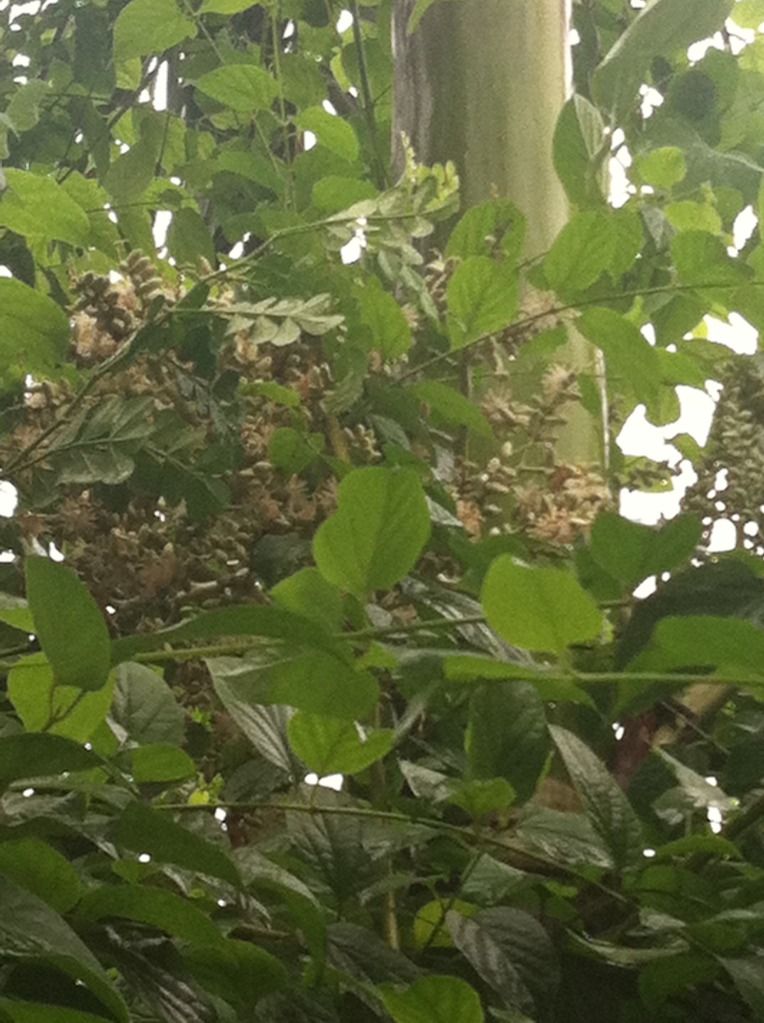
As a new bee keeper in Florida it is important to know what plants are in bloom in your area. Here is a recommendation from the University of Florida on the management of beekeeping in the state of Florida. http://edis.ifas.ufl.edu/in848. As an organic beekeeper keeping TBH, I do not agree with pest management, but would rather have a strong hive with good strong feral stock, allowing them to draw out their comb naturally without foundation. Hopefully this organic way of beekeeping will allow them to manage their pest without the use of artificial pesticides. I do however; use this page to follow what plants are in bloom in the state of Florida. Right now in my back yard my palm trees are blooming. Last week when I was looking for the Atala butterfly in my yard, I also discovered all the bees and blooms around the Christmas tree palms. It was amazing because there were so many bees around these blooms.

The bees seem happy in my yard. If those are not my exact bees at least I am providing enough nectar and pollen sources to keep the foragers happy.
I went back into my hives and they are looking very good. I need to split my 4th hive again. The queen in that hive is so productive. Her laying pattern is amazing!! I feel like I am raising a “box of brood.” That hive doesn’t produce a lot of honey but has allowed me to make several divides this year. As I inspected hive #3 I found a ball of bees. My mentor Inese was with me and she thinks they were balling the queen. We did find eggs, larvae, and capped brood present in the hive, but we would expect to since they were balling her as we entered the hive. This behavior from what I have read is very typical of Africanized Bees. I need to go back into that hive in a few days to see if there are queen cells present then I will know for sure whether it is queenless or not.
The bees were very gentle the other day. I didn’t receive any stings, which was greatly appreciated. However their behavior lately has been extremely irritable. As a beekeeper I try to understand what might be making them irritable. Their hives are not over crowded, they are not honey bound, but two weeks ago hive #2 was queenless with numerous queen cells present. Now hive #3 may be without a queen, if in fact they were balling her. Hive #4 has room in the brood area but the hive is almost full and needs to be split. The nectar flow in July and August is not good. All these examples can make bees irritable. I know my bees do get aggressive when they are queenless because they have chased me around the yard. Last week they stung my pool guy and this week they stung the yard guy several times, enough that he needed to go to the clinic. From what I could find out he is ok but my yard men are not coming back until I get rid of the bees. My husband is concerned because he doesn’t want the bees harming anyone, I mean, I could have died a month ago from my anaphylactic reaction and we cannot afford to have anything happen to anyone either. So right now I am very upset because I really do not want to get rid of my bees. My beekeeping started because I wanted to help the bees but I can also honestly say that I enjoy all aspects of beekeeping from taking care of the hives, to all the wonderful by-products the hive provides.
I talked to my mentor Kate out in Santa Fe Saturday morning. We decided that this might be the perfect time to requeen the hive. Since I need to spilt hive #4 this week, I could get a nice Italian queen instead of allowing that hive to make a queen, and then I might be able to see if I notice a difference in temperament. If I do I may actually requeen all the hives except hive #4 since that queen is my best laying and strongest hive. I know that a strong feral hive is the best, more resistant to disease and pest, more acclimated to my environment. Having aggressive bees doesn’t exactly make my beekeeping hobby enjoyable. As Kate has said to me “Life is too short to have mean bees.” I do not need to be worrying about the safety of myself or others. So I have decided that getting a new queen might be the answer. I guess time will tell…. Hence the saga continues…. Wish me luck!
 |  |
 |  |
The bees seem happy in my yard. If those are not my exact bees at least I am providing enough nectar and pollen sources to keep the foragers happy.
I went back into my hives and they are looking very good. I need to split my 4th hive again. The queen in that hive is so productive. Her laying pattern is amazing!! I feel like I am raising a “box of brood.” That hive doesn’t produce a lot of honey but has allowed me to make several divides this year. As I inspected hive #3 I found a ball of bees. My mentor Inese was with me and she thinks they were balling the queen. We did find eggs, larvae, and capped brood present in the hive, but we would expect to since they were balling her as we entered the hive. This behavior from what I have read is very typical of Africanized Bees. I need to go back into that hive in a few days to see if there are queen cells present then I will know for sure whether it is queenless or not.
The bees were very gentle the other day. I didn’t receive any stings, which was greatly appreciated. However their behavior lately has been extremely irritable. As a beekeeper I try to understand what might be making them irritable. Their hives are not over crowded, they are not honey bound, but two weeks ago hive #2 was queenless with numerous queen cells present. Now hive #3 may be without a queen, if in fact they were balling her. Hive #4 has room in the brood area but the hive is almost full and needs to be split. The nectar flow in July and August is not good. All these examples can make bees irritable. I know my bees do get aggressive when they are queenless because they have chased me around the yard. Last week they stung my pool guy and this week they stung the yard guy several times, enough that he needed to go to the clinic. From what I could find out he is ok but my yard men are not coming back until I get rid of the bees. My husband is concerned because he doesn’t want the bees harming anyone, I mean, I could have died a month ago from my anaphylactic reaction and we cannot afford to have anything happen to anyone either. So right now I am very upset because I really do not want to get rid of my bees. My beekeeping started because I wanted to help the bees but I can also honestly say that I enjoy all aspects of beekeeping from taking care of the hives, to all the wonderful by-products the hive provides.
I talked to my mentor Kate out in Santa Fe Saturday morning. We decided that this might be the perfect time to requeen the hive. Since I need to spilt hive #4 this week, I could get a nice Italian queen instead of allowing that hive to make a queen, and then I might be able to see if I notice a difference in temperament. If I do I may actually requeen all the hives except hive #4 since that queen is my best laying and strongest hive. I know that a strong feral hive is the best, more resistant to disease and pest, more acclimated to my environment. Having aggressive bees doesn’t exactly make my beekeeping hobby enjoyable. As Kate has said to me “Life is too short to have mean bees.” I do not need to be worrying about the safety of myself or others. So I have decided that getting a new queen might be the answer. I guess time will tell…. Hence the saga continues…. Wish me luck!
Thursday, August 23, 2012
The Atala Butterfly

I have been butterfly gardening for years and it is very hard to attract the Atala Butterfly. The Atala Butterfly (Eumaeus atala) is a small but beautiful butterfly that was almost extinct but is making a comeback. Its coloring is amazing with black wings, on orange red abdomen and fluorescent blue spots. Common names for the Atala butterfly are the Atala, Atala hairstreak, and Coontie Hairstreak. The Atala butterfly can be found in Southeastern Florida, the Bahamas, and Cuba. The Atala butterfly has been reported from Dade County north up to Martin County, Florida.
Like all butterflies, atalas need a specific host plant on which their larvae feed. The host plant for atalas is a coontie, a relative of the sago palm whose primary natural habitat is pine flatwood. When I first started to garden for butterflies I planted a few (1-2) Coontie plants thinking that would be enough to attract the butterfly. I was wrong and later found out that you needed many (20) coontie plants to attract the atala butterfly. Fairchild Garden does a beautiful job attracting the atala but they have so many coonties planted. When I visit Fairchild’s Butterfly Garden you can see the atala larvae on the coontie plants.

 |  |
Coontie plants contain a natural toxin, which atala larvae accumulate in their bodies and use to repel birds. Without coontie, adult atalas have no place to lay eggs and no eggs means no new generations. Wild coonties’ demise began with starch: Long before Europeans arrived in Florida, Native Americans used coontie as a source of starch. Coontie, in fact, is a Seminole word that means “bread” or “white root” because the roots can be made into flour. Settlers continued the practice on an industrial level. In the early 1900s, several commercial factories in South Florida processed coontie roots for the manufacture of arrowroot biscuits. Coontie plants started disappearing throughout Florida, and so did the atala butterfly. By 1965, federal and state authorities thought the atala was extinct. The atala is making a comeback because people are using coontie in landscaping and because people are becoming interested in butterflies.

During this year I have noticed several atalas in my garden. The first time I saw one I thought I had to be mistaken. I only have one coontie plant so I thought there was no way I would have the atala in my yard, but I do. In fact I have several atalas in the back of the yard by several flowering palm trees and the logustrum tree. Adult butterflies take flower nectar and sometimes roost in trees. This is why I think they were in the back of the yard around the flowers of the palms and were roosting on the logustrum tree. I also have several other Florida natives that are nectar sources for the Atala, i.e. spanish needle, butterfly bush, lantana, pink powderpuff, etc. I am so happy to have this little visitor in my yard.
Subscribe to:
Posts (Atom)